
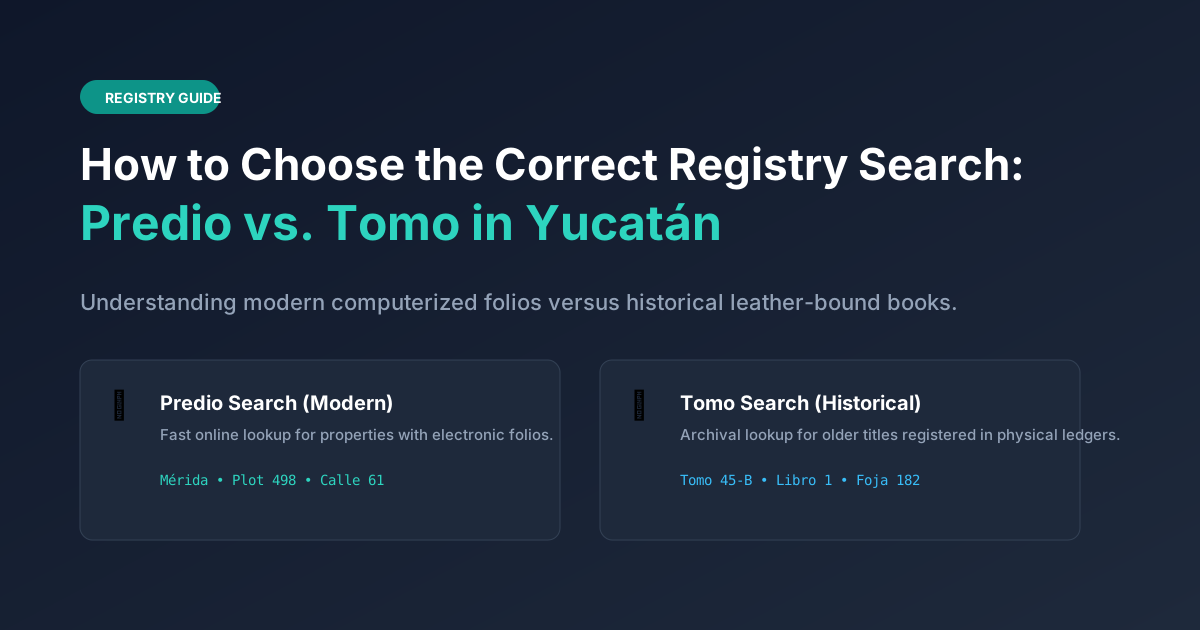
How to Choose the Correct Registry Search: Predio vs. Tomo in Yucatán
When querying property records in Yucatán through the RPP, should you query by Predio or by Tomo? Learn how digitized folios differ from historical ledger books.
Read Guide →Explore public property registry searches, cadastral certifications, fee calculators, notary directories, and title due diligence through interactive, step-by-step civic tools.
Practical, browser-based decision wizards, financial calculators, and preparation checklists designed to eliminate delays before accessing official government portals.
Prepare search parameters for modern Predio folios, historical Tomo ledger books, and commercial company records.
Open Search Assistant →Calculate estimated municipal ISAI acquisition tax (2.0% - 2.5%), INSEJUPY recording rights, and Notario protocol costs in MXN.
Open Calculator →Diagnose agrarian legal risk before putting down earnest deposits. Check Certificados Parcelarios and Dominio Pleno status.
Assess Agrarian Risk →Interactive document checklist for Cédula Catastral, Constancias, and official cadastral plan requests with live progress.
Build Checklist →Find your filing folio, understand suspended (SUSPENDIDO) status codes, and launch verified official tracking portals.
Track Filing Status →Comparison matrix for Libertad de Gravamen (Freedom from Liens), Historial Registral, and No Propiedad certificates.
Compare Certificates →Learn how to verify official electronic certificates, cryptographic digital stamps (sello digital), and authentic QR codes.
Verification Guide →21-point printable checklist covering title validation, cadastral alignment, ejido warnings, and Notario closing safeguards.
Open Checklist →Search certified Notarios Públicos authorized to close and record property deeds into INSEJUPY across Mérida, Progreso, and Valladolid.
Find a Notary →These links connect directly to authoritative state platforms. All external links open securely in a new browser tab with strict security protections.
Everything property buyers, legal professionals, and homeowners need to know about the Instituto de Seguridad Jurídica Patrimonial de Yucatán—from the dual architecture of RPP and Catastro to statutory closing taxes and foreign buyer trust regulations.
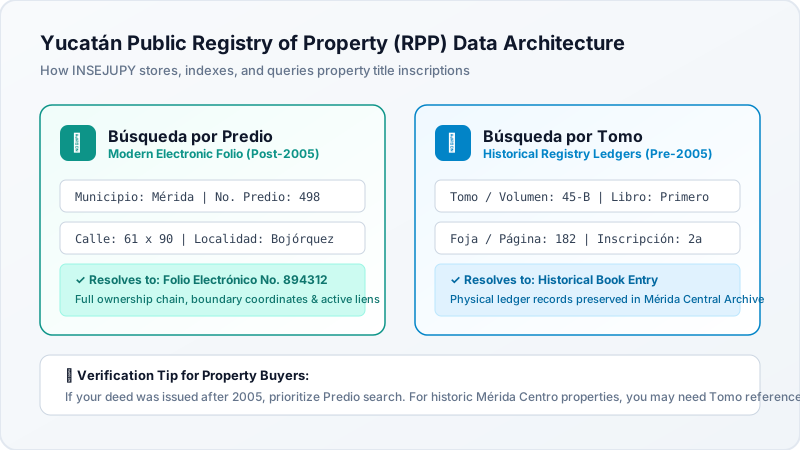
Created under the Ley del Instituto de Seguridad Jurídica Patrimonial de Yucatán, INSEJUPY is the autonomous state executive agency responsible for certifying, protecting, and publicizing property rights and commercial entities throughout the State of Yucatán. Unlike many other Mexican federal states where the property registry and the cadastral administration exist as separate, disconnected bureaucracies, Yucatán unified both divisions under a single institutional roof in 2011.
This unified architecture consists of two primary operational branches:
When consulting the public registry database online through the Government of Yucatán portal, users must immediately distinguish between modern electronic folios and historical archive books:
| Feature | Modern Predio (Folio Electrónico) | Historical Tomo (Libro / Foja) |
|---|---|---|
| Search Parameters | Municipality, Locality, Street, and Predio Number | Tomo (Volume), Libro, Volumen, Foja, and Inscripción |
| Record Format | Computerized digital ledger with unique electronic folio ID | Handwritten or typed leather-bound physical archive ledger |
| Query Turnaround | Instant online database results in real-time | Physical archivist lookup (may require 2–5 business days) |
| Typical Era | Properties modernized or transferred post-2000 in Mérida/Progreso | Historical colonial homes, family estates, or un-transferred rural land |
Under Article 27 of the Mexican Constitution, foreign individuals cannot hold direct deed title to real estate located within the "Restricted Zone" (Zona Restringida)—defined as within 50 kilometers (31 miles) of the Mexican coast or 100 kilometers of land borders. Because the coastal municipality of Progreso, along with Sisal, Chelem, Chicxulub, and Telchac Puerto, lie squarely within the 50-kilometer coastal boundary, foreign purchasers must acquire real estate through a bank trust (Fideicomiso) or through a Mexican corporation (if commercial/non-residential).
In a Fideicomiso, a Mexican fiduciary bank holds legal bare title while the foreign purchaser holds 100% beneficial ownership rights for a 50-year perpetually renewable term. Crucially, the master Fideicomiso deed must be recorded directly in the INSEJUPY electronic database, accompanied by the official permit number issued by the Ministry of Foreign Affairs (Secretaría de Relaciones Exteriores - SRE).
Verify that the seller is the registered legal owner on the Folio Electrónico and request an official Certificado de Libertad de Gravamen to confirm zero liens, mortgages, or embargoes.
Ensure the physical perimeter walls or surveyed boundary points correspond precisely with the measurements recorded at Catastro. Discrepancies must be corrected before deed signing.
The designated Notaría Pública files an Aviso Preventivo in the INSEJUPY folio, freezing title against competing third-party encumbrances for 30 business days.
Obtain municipal tax solvency certificates (Constancia de No Adeudo de Impuesto Predial) and calculate the municipal transfer tax (ISAI 2.0% - 2.5%).
Parties sign the formal protocol volume deed. The notary withholds statutory taxes and validates payment funds.
The notary transmits the deed into INSEJUPY. Upon registration, the buyer receives the certified Primer Testimonio bearing official electronic stamps and QR codes.
In-depth procedural analysis, fee schedules, legal requirements, and due diligence breakdowns.
When querying property records in Yucatán through the RPP, should you query by Predio or by Tomo? Learn how digitized folios differ from historical ledger books.
Read Guide →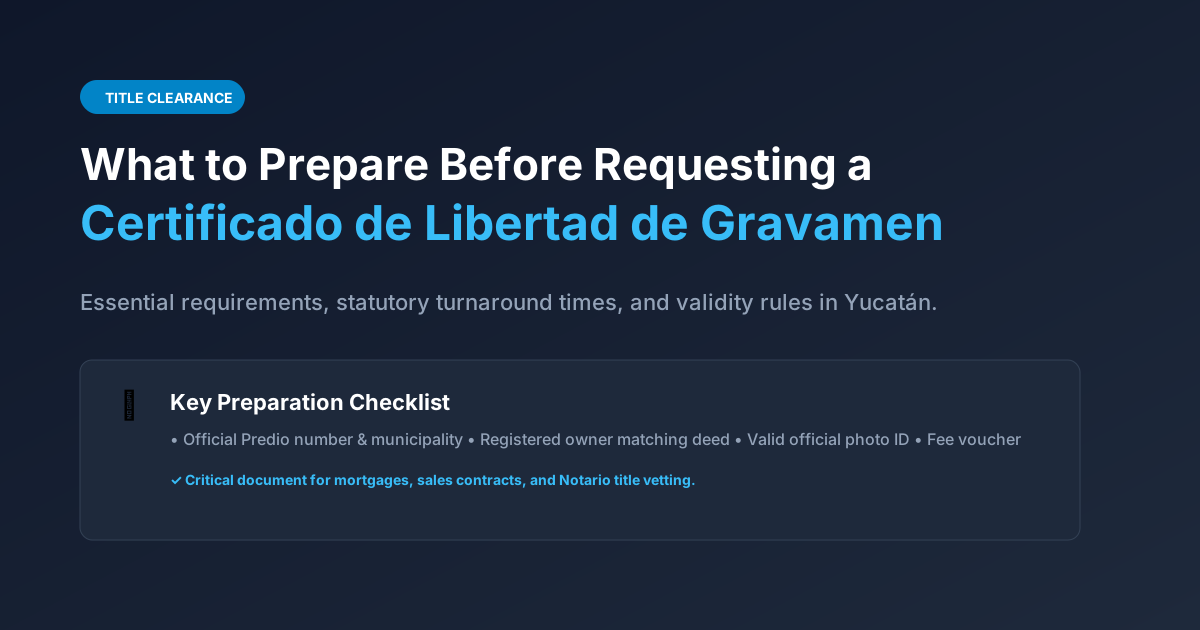
The single most critical preliminary certificate in Mexican real estate. Learn prerequisites, processing times, and how to verify clear title before buying.
Read Guide →Authoritative clarifications regarding public registry searches, cadastral records, fee schedules, and independent assistance tools.
INSEJUPY Guide is an independent, English-language civic assistance portal created for residents, foreign property buyers, researchers, and legal assistants navigating property registry and cadastral procedures in Yucatán, Mexico.
Last Editorial Audit: October 2026. Official procedures are subject to legislative changes by the state government.